Balkland is a luxury tour operator and destination management company from Sarajevo. It runs private, tailor-made and small-group tours across ten Balkan countries, for travellers who mostly book from abroad.
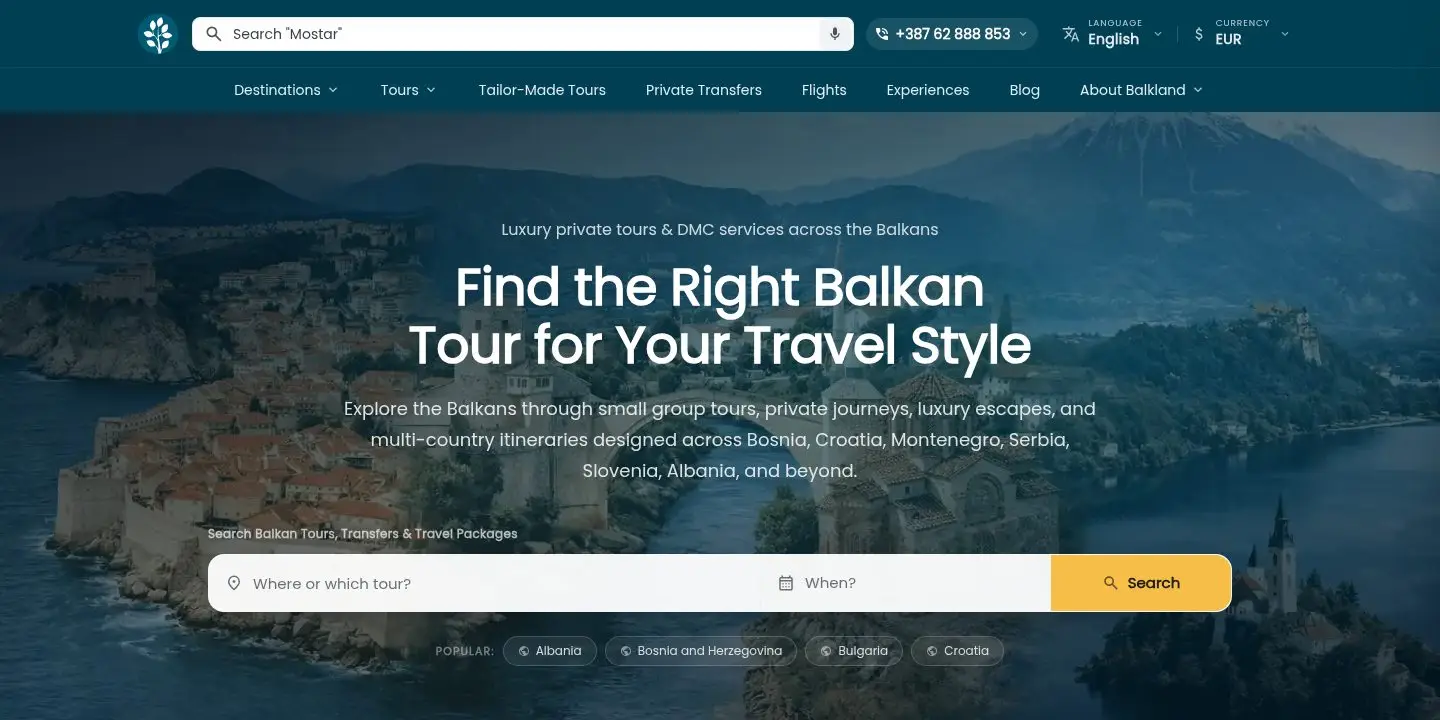
In March 2026 we replaced Balkland’s WordPress site with a new platform that we designed and built. Travellers now find a tour in their own language, pick a date and book it on the same page. This is what changed, and what the numbers have done since.
- Active users
- 75K
- +331.2%
- Page views
- 92K
- +144.5%
- Events
- 321K
- +199.4%
- Purchases
- 25
- +177.8%
Where Balkland started
The old site was a custom WordPress theme on shared hosting, held together by plugins for sliders, reviews, image compression, caching and SEO. It worked, but it was built for one language and one market, and it was hard for search engines to read:
- One language in practice. A translation plugin switched the text in the browser, but there were no separate pages per language and no hreflang, so search engines only ever saw the English site.
- Weak search basics. Meta descriptions repeated the page title or listed keywords, URLs mixed query strings like
?tourcat=with emoji, and the structured data only described the company, not its tours. - Booking in someone else’s box. Tour dates and checkout came from embedded third-party widgets, so the most important step of the journey looked and behaved differently from the rest of the site.
What we built
We designed the new site around the way people choose a tour: where they want to go, when, and with whom. Underneath, it is a Nuxt front end with a Directus CMS, served through Cloudflare.
Ten languages, each with its own pages
English, German, Spanish, Italian, Chinese, Japanese, Hebrew, Russian, Arabic and Korean, each on its own URLs and linked with hreflang in the sitemap.
Booking on the tour page
A date calendar, room packages, deposits and a booking summary sit on the tour page itself. The payment provider only handles the payment.
Structure search engines understand
Consistent URLs for tours, destinations and travel guides, canonical tags, Open Graph, and TravelAgency, WebSite and FAQ structured data.
Fast, private and locked down
Pages are cached at the edge, images load lazily, analytics only starts after cookie consent, and HSTS, a content security policy and frame protection are on.
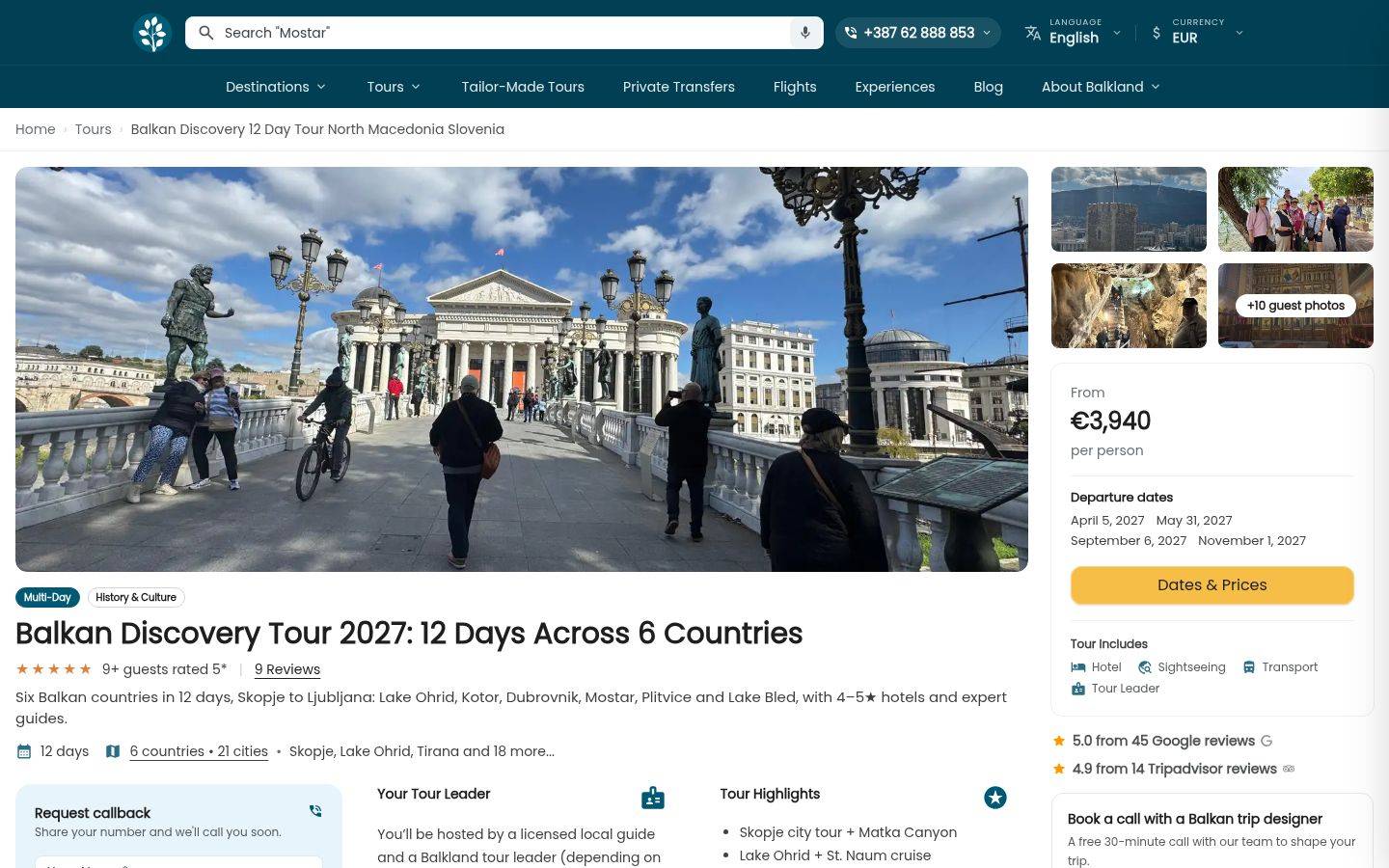
The table below sums up the difference between the two sites, as they appear in the Wayback Machine in February 2026 and on balkland.com today.
| Area | Before | After |
|---|---|---|
| Platform | WordPress theme on shared hosting | Nuxt and Directus, served through Cloudflare |
| Languages | Browser-side translation, no language URLs | 10 languages with their own URLs and hreflang |
| Booking | Embedded third-party widgets | Calendar, packages and booking summary on the tour page |
| Structured data | Organisation only | TravelAgency, WebSite and FAQPage |
| URLs | Query strings and emoji | Clean paths for tours, destinations and guides |
SEO built into the platform
Most travellers start planning a tour on a search engine, so we built search into the platform itself instead of adding it later with a plugin. The clearest sign it worked: Google went from 134 valid indexed pages to 1,100 within days of the launch.
- Valid pages indexed by Google
- 134 → 1,100
- Old WordPress URLs redirected or retired
- 193
- Lighthouse mobile performance, up from 60–65
- 86–98
- Languages, each with its own URLs
- 10
- Nothing lost in the move. Every old WordPress URL was mapped: 170 permanent redirects to the matching new page and 23 pages marked as gone, so the links and rankings the old site had earned carry over.
- A page for every search. There are 118 tour landing pages, one for each country, city, attraction and travel style people search for, from Bosnia and Herzegovina tour packages to Plitvice National Park and multi-day tours. Next to them sit tour pages, travel guides and the blog, all linked to each other through countries and cities.
- Every page in ten languages, natively. Each language has its own sitemap of about 400 URLs, with translated paths, even in Korean and Arabic script, and right-to-left layouts for Hebrew and Arabic. Every URL lists its translations and an x-default with hreflang, and new content in the CMS is translated automatically when it is published.
- Data search engines can use. One TravelAgency entity tied to Balkland’s Wikidata entry, awards and memberships, and structured data for every tour (TouristTrip with the day-by-day itinerary, Product with its price), breadcrumbs, articles and FAQs. Star ratings were left out on purpose, to stay within Google’s rules on self-serving reviews.
- Only pages worth indexing. Titles and descriptions follow length rules, thin pages such as deep archive pages are kept out of the index, IndexNow tells search engines about changes, and listing pages render on the server so that crawlers and AI assistants can read them.
- A cleaner link profile. We reviewed the links pointing at balkland.com and flagged 128 spam domains for disavowal.
- Fast pages. We cut the homepage’s inline CSS from 262 KB to 51 KB and its data payload from 360 KB to 85 KB, replaced a 902 KB map with a 37 KB image, and moved Tag Manager behind cookie consent. Lighthouse mobile scores went from 60–65 to 86–98 across the main page types.
Results
The new site went live in March 2026, and that is where Balkland’s active-user curve steps up and stays up. Compared with the previous period, active users are up 331.2%, page views 144.5% and purchases 177.8%.
Two things are worth knowing when you read those numbers. The comparison covers the whole year to date, so January to early March still ran on the old site. And on the new site, analytics only loads after a visitor accepts cookies, so everyone who declines is missing from these figures. Both make the real change larger, not smaller.